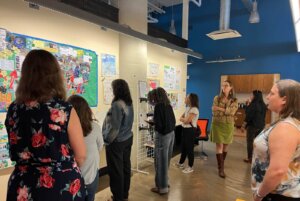
Since 2022, the California Environmental Literacy Initiative (CAELI) County Office of Education (COE) Fellowship program has helped catalyze something much bigger than a professional learning experience. It has helped grow a statewide movement for environmental leadership in TK-12 schools, rooted in and supported by County Offices of Education.
What began as a targeted effort to support a small group of leaders has evolved into a powerful engine for systems change. Across California, County Offices of Education are increasingly investing in environmental and climate literacy, and not as standalone initiatives, but as a core strategy for student success, community resilience, and long-term sustainability. Today, that shift is visible not only in stories, but in data, partnerships, and sustained leadership.
Since 2017, the number of COEs actively engaging in environmental and climate initiatives has steadily grown, with Fellowship participants playing a catalytic role in that expansion. The chart below shows the number of county offices of education making a range of investments, from policy adoption and staffing to participation in statewide networks and recognition programs.
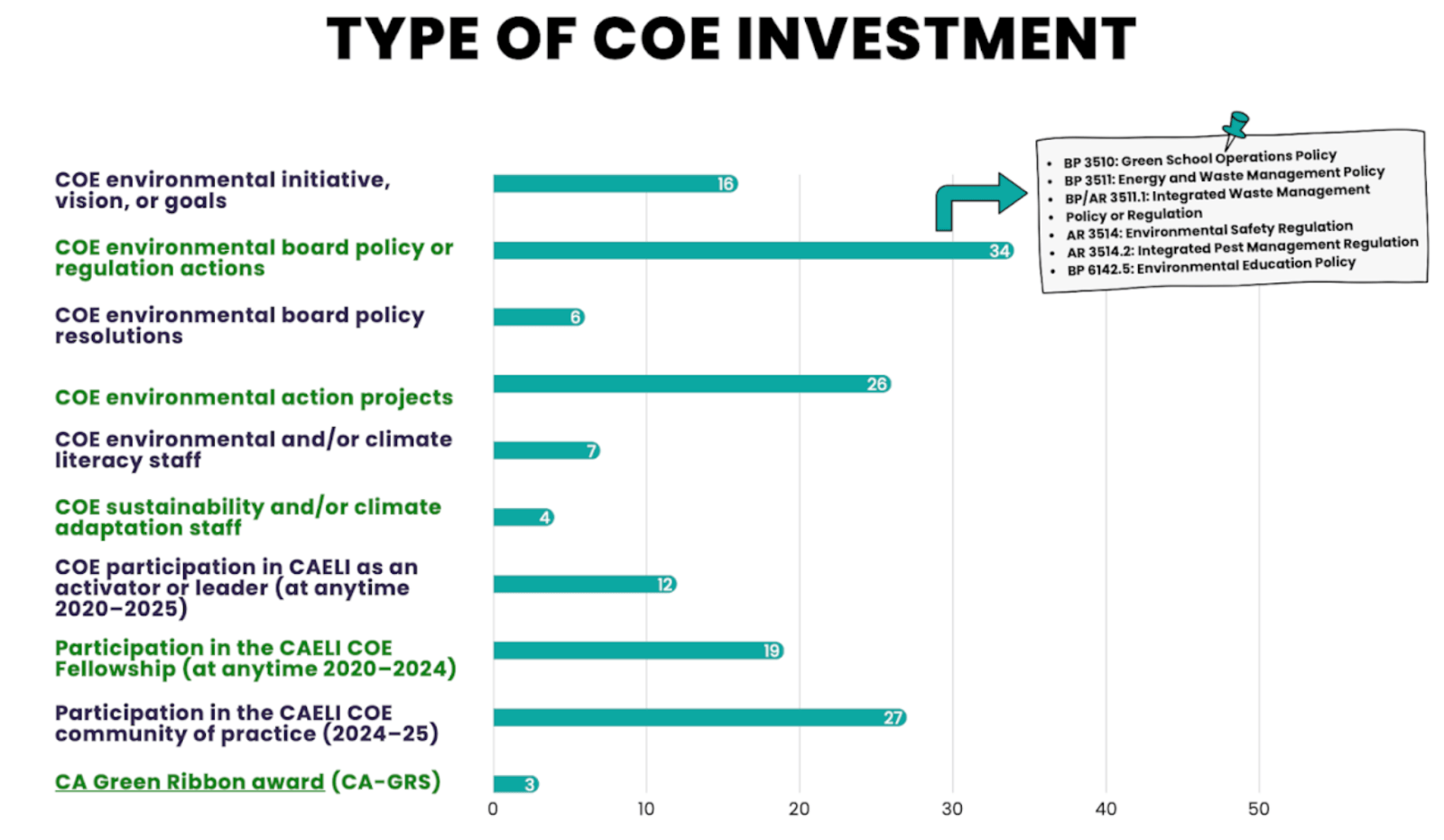
The iterations of the fellowship have demonstrated that investments in leadership, networks, and capacity at the county level can help move environmental and climate action in schools from being isolated pockets of effort toward becoming coordinated, sustained, and increasingly visible champions of systems change across the state.
Why the CAELI COE Fellowship Matters
The Fellowship was designed to address two connected needs:
- To build statewide capacity within County Offices of Education to lead environmental and climate work.
- To move from isolated efforts to coordinated, systemic regional impact.
From the beginning, the vision was to support environmental literacy leadership across all 58 County Offices of Education, with a long-term goal of establishing a dedicated Environmental Literacy and Sustainability Coordinator in every county.
When the program was initiated in 2022, most efforts at individual County Offices of Education were fragmented, dependent on individual champions, and difficult to sustain. The Fellowship invested in people, equipping them with tools, strategy, and a network to build lasting systems. This shift represents a move from passion projects to infrastructure.
| “The fellowship just came at a time that helped me rethink our leadership role in the county office.” —Cohort 1 Fellow |
| “The fellowship was a unique opportunity for us to work as a team to bring together different roles and responsibilities to think critically about environmental literacy and sustainability in our programs.” —Cohort 2 Fellow |
| “This fellowship set a high standard for what a COE can do for environmental literacy and showed us strategies to set and achieve goals. I think seeing all of the possible outcomes helped put our current position in perspective and motivated us to dream big.” —Cohort 3 Fellow |
Participants described a shift from adding new programs to integrating into existing systems, from working independently to building partnerships, and from short-term efforts to long-term planning. This demonstrates an important shift in how leaders think and operate when implementing broadscale initiatives. Participants reported overwhelmingly that the program increased their capacity to implement change in their local regions.
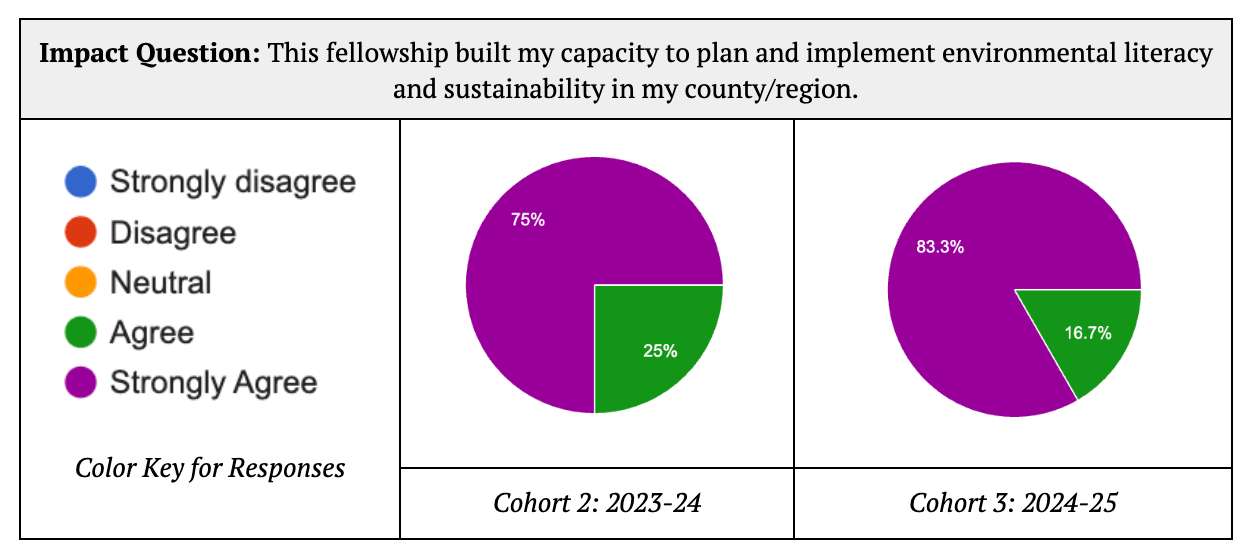
Case study analysis shows consistent outcomes including growth in facilities knowledge, expansion of partnerships, and launch of new initiatives such as environmental literacy summits and student programs. The case studies from the first three years of the program are available to explore at 2022-23, 2023-24, 2024-25.
“This fellowship has helped me in so many ways. It has helped to stretch my thinking of the things that are possible, resources that are out there, ways to connect with others (both within and outside of my organization), and really how to ground myself within the work.” —Cohort 1 Fellow “A key growth area for me was being able to identify leverage points for change. It provided strategies for me to identify the need, the why, and the audience and then look for partners and build relationships with districts and schools to implement.” —Cohort 2 Fellow “The fellowship provided me with connections to others in the field, research that supports the work I want to do, different presentation styles, and ideas for braiding different initiatives.” —Cohort 3 Fellow “The fellowship provided great resources and case studies that shaped my mindset and understanding. This helped me rethink my goals and hopeful outcomes.” —Cohort 2 Fellow
Another key way this program has made a difference is that despite operating at the county level, the fellowship has shown impact reaching districts, schools, and students. This impact is illustrated in profiles of several of the participating counties. Across regions, this work has expanded outdoor learning, strengthened curriculum, improved campus sustainability, and increased student engagement.
“Something I spent time rethinking during the fellowship is our ‘Growing Gardens Community of Practice.’ As I deepen this work, it continues to be a great network and has become an example for other COEs across the state.” —Returning fellow at the alumni reunion, April 2026 “One of the programs we developed as an outcome of this fellowship is taking hold. Now our superintendent wants us to eventually share this out with districts.” —Returning fellow at the alumni reunion, April 2026
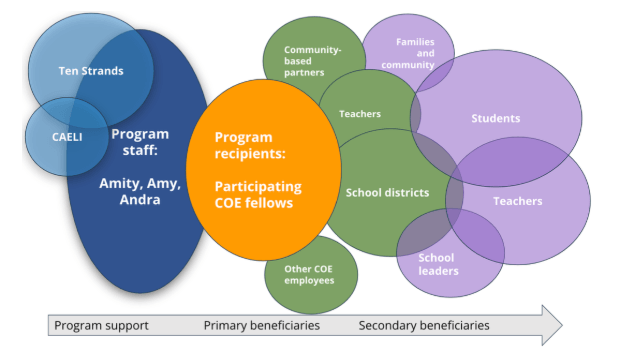
Stakeholder Analysis of Program Support and Beneficiaries
Lessons Learned
After four years of implementation, clear patterns have emerged regarding both the challenges and the conditions for success for environmental initiatives in county offices of education. Across counties, the most consistent barriers include:
- Limited funding and complex funding pathways
- Staff capacity and competing priorities
- Leadership transitions that disrupt momentum
- Gaps in technical knowledge, particularly related to facilities and operations
These challenges are not unique to environmental work—they are structural features of the education system. What is notable is how fellows learned to navigate them. Rather than attempting to build entirely new systems, many COE leaders have found success by focusing on integrating environmental literacy and action into required accountability mechanisms and other ongoing initiatives. For example, leaders embedded environmental priorities into:
- Multiple curricular subject areas
- Ongoing initiatives related to student wellness, equity, and community engagement (such as STEAM expos and book fairs)
- Existing plans such as LCAPs and Facilities Master Plans or policies such as AB 1548 (EP&Cs), AB 285 (climate literacy in science instruction), and SB 1383 (recycling and compost waste diversion)
Another key strategy that COE leaders discovered was introducing focused pilot efforts that could demonstrate value and build momentum for broader implementation. For example:
- Green classroom challenges or other awards-based programs
- Environmental literacy summits
- Environment-focused teacher professional development
- Youth engagement programs
Lastly, COE leaders identified that leveraging partnerships (for example, partnering with external organizations or aligning efforts across other county agencies) has helped to expand capacity. All of these approaches point to an important pattern that demonstrates how progress in this space is less about adding new work and more about reshaping how existing work is done.
| “The fellowship showed me the opportunity of using an integrated approach to all subject areas that demonstrate how all of these subjects can come together and be fully integrated with environmental literacy and sustainability. I think if we do that well, we can really change education in many positive ways.” —Cohort 1 Fellow |
| “One thing that has really stuck with me is the systems thinking and entry-point activity we did at the start of the fellowship. It helped me identify different strategies for my plan and taught me that success is more likely when we can build partnerships across our COE departments.” —Cohort 3 Fellow |
| “A key takeaway I have from this fellowship is that leading systemic change is a team effort and those who are working together must have a common language for doing the work. It also requires a multifaceted approach that requires work across different components of the system—Campus, Curriculum, Culture, and Community—and different scales of the system, including the classroom, district, COE, and the community at large.” —Cohort 2 Fellow |
| “Through this fellowship we learned to build environmental literacy into the existing networks that are already there and not duplicate efforts. Ultimately, we learned to slip it in rather than wedge it.” —Cohort 2 Fellow |
What Comes Next
The first phase of the Fellowship focused on building a core group of leaders—many of whom already held or were moving into roles specifically connected to environmental literacy and sustainability. This approach helped to demonstrate what is possible when dedicated capacity exists. However, what is emerging is a broader and more distributed form of leadership.
Individuals in a wide range of COE roles are now engaging in this work, including staff working in varied capacities such as:
- Non-science curriculum and instruction positions
- Early Learning
- Expanded Learning and after-school programs
- Student Services, including health and wellness
- Emergency preparedness and safety coordination
- Facilities, operations, and business services
In many cases, these individuals do not have environmental literacy in their job titles or responsibilities. They are choosing to integrate this work into their existing responsibilities because they see its relevance to their core priorities. While the COE Fellowship did have a few participants in each cohort in this situation, now most fellows will be operating without:
- Dedicated time
- Formal role alignment
- Structured support or professional learning
In response, the next phase of the CAELI COE Fellowship will more formally expand both its audience and its design in the 2027-28 school year. The program will openly recruit for participants who want to integrate environmental and climate literacy into their existing work. This intentional shift will support and advance environmental work as a shared responsibility across the system, even when there is no dedicated Environmental Literacy and Sustainability role, and will help to:
- Accelerate adoption across more counties
- Strengthen connections between departments
- Build momentum toward long-term structural change
Call to Action for Investment and Leadership
This is a pivotal moment for California to catalyze a paradigm shift towards an environmentally sustainable and climate-resilient existence. If California is serious about preparing students for the future and meeting its climate goals, then investment in educational systems must reflect that priority. County Offices of Education are uniquely positioned within the TK-12 education system to lead this work at scale, but they cannot do it without sustained support.
It is critical that funders, educational leaders, and policymakers work together to establish dedicated funding to support environmental literacy and sustainability leadership across all COEs, including staffing, professional learning, and implementation support. The last few years have proven that ongoing investment in this work at the COE level can lead to systems-level change.
At the ground level this moment is also an opportunity for educational leaders at County Offices of Education to build on the momentum, as what began as a fellowship is now a movement. The next phase will determine whether it reaches every county, every district, and every student in California.
Check out Past Articles about the COE Fellowship Below:
- February 2023: COE Fellowship Graduates Its First Cohort
- May 2024: Celebrating the Second COE Fellowship Cohort Graduation
- May 2025: Celebrating the 2024-25 CAELI COE Fellows